November 2025
4 Min
Why Calendar Vendor APIs Are Fundamentally Incompatible (And Why Synara Has to Bridge Them)
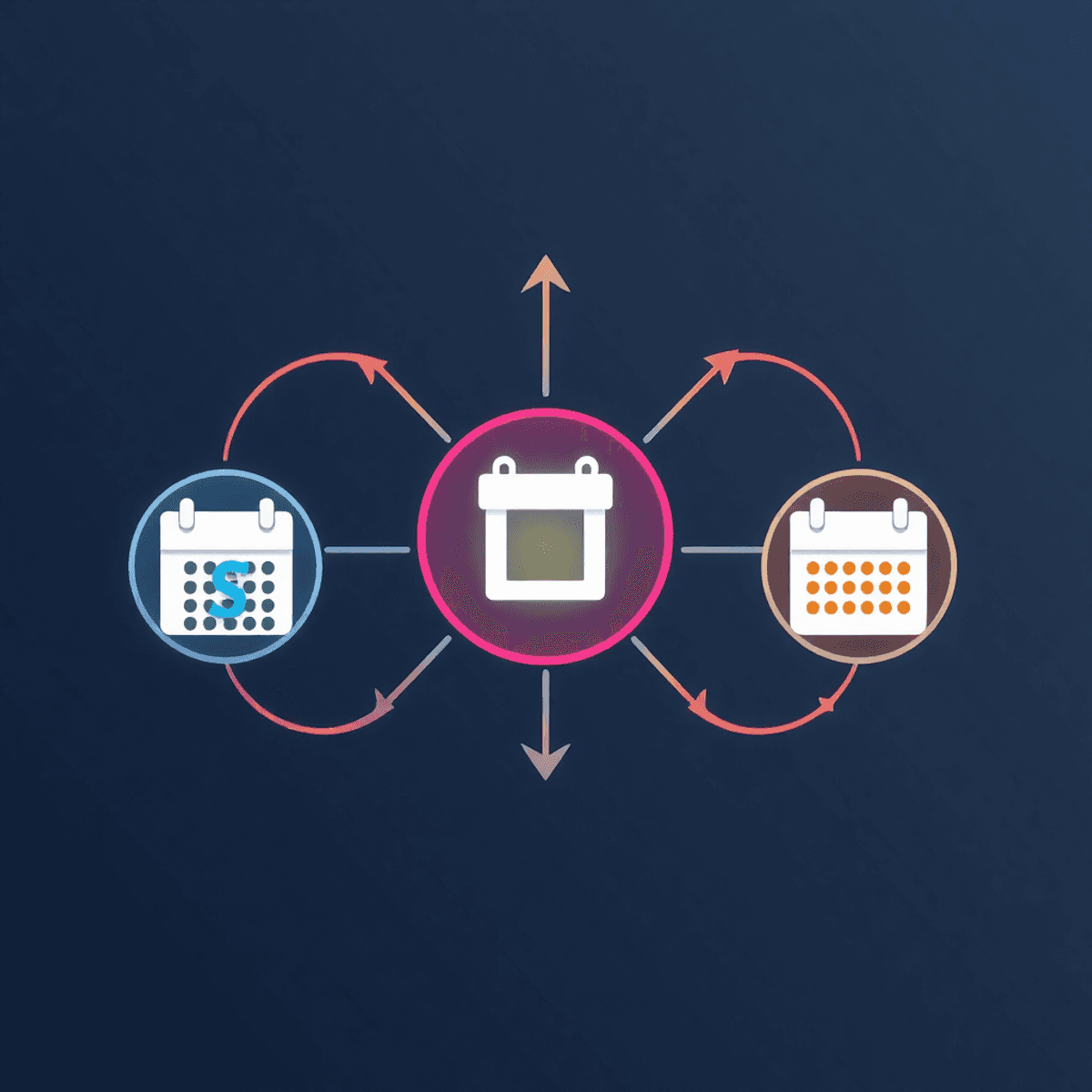
Google, Outlook and Apple all interpret events differently — from recurrence to timezones to RSVP flows. These differences aren’t bugs; they’re architectural. This post breaks down why no developer can reliably unify vendor calendars on their own, and how Synara uses ACE and JSCalendar to provide one consistent model.

Sam Benson
Nov 25, 2025
When developers talk about calendar integrations, they usually describe the experience as “inconsistent,” “messy,” or “surprisingly complicated.” All true — but none of those words describe the real problem.
The problem isn’t that Google, Outlook and Apple Calendar behave differently.
The problem is that they behave differently by design.
The more you learn about each vendor’s event model, the clearer it becomes: these systems were never meant to interoperate cleanly. They were built years apart, with different assumptions, different priorities, and entirely different underlying structures. Anyone trying to unify them ends up fighting the foundations, not the surface issues.
Let’s break down why.
Google’s model is loosely based on RFC5545, but it extends and relaxes large parts of it. Outlook uses Exchange semantics and serialisation, which resolve recurrence and timezones differently. Apple’s model is closest to ICS, yet behaves unpredictably around recurring events and attendee updates.
None of these systems exposes a strict, shared representation of an event. Even when all three accept ICS, they don’t interpret it the same way. It’s like trying to make three programming languages execute the same script without a compiler.
This is one of the core reasons Synara converts JSCalendar → ACE internally. Without a stable, internal representation, everything eventually falls apart.
Every vendor supports recurrence, but none supports it in the same way.
This makes round-tripping impossible. You can generate a rule, send it to all three, and end up with three slightly different events after import.
Synara solves this by giving you one stable recurrence model (ACE) and handling the conversion on its side. Without this barrier, developers end up writing per-vendor recurrence logic indefinitely.
Two recurring problems:
Even if you generate valid ICS with the correct VTIMEZONE block, there is no guarantee every client will apply it in the same way.
When Synara receives JSCalendar, it normalises timezone handling into ACE before anything else happens. This eliminates vendor-induced drift — a problem that normal ICS workflows can’t prevent.
Google may send a change notification.
Outlook may update the event but send nothing.
Apple might accept without broadcasting any change at all.
Two implications:
This is the main reason Synara sends every attendee response through ACE webhooks. You always know what happened, regardless of whether a client cooperated.
Google has webhooks (sometimes).
Microsoft has Graph notifications (often delayed).
Apple has no webhook equivalent at all.
Even if you built three separate webhook systems, you’d still deal with:
Synara’s single webhook layer gives you consistent event lifecycle updates even if the vendor never sends a thing.
ICS is a transport format, not a state container. It doesn’t handle:
Developers try to use ICS as if it were a database record. It isn’t — and that’s why so many systems break when clients mutate the ICS differently.
Synara uses ICS purely as a fallback output — not as a source of truth — and keeps ACE as the authoritative state.
A reliable, cross-vendor calendar layer cannot be built by patching over these differences.
You need:
That’s what Synara provides.
Without a compatibility layer that understands the quirks of each vendor and shields developers from them, any integration eventually degrades into a pile of conditional logic.
Synara’s value isn’t “simplifying invites.”
It’s providing a single, consistent mental model for an ecosystem that fundamentally lacks one.
You might also like
Browse all articles
Dec 2025
9 months ago
ICS Timezone Wrong in Google Calendar: Why Events Shift and How to Fix It
This article explains why Google Calendar shifts event times, how timezone normalisation really works, and what you must...
Dec 2025
10 months ago
What happens after a user subscribes: why calendars stop updating and how to handle it reliably


Synara is calendar delivery infrastructure for products that can't afford broken invites. One API to keep every attendee in sync across Google, Outlook, Apple and more.